

Communication skills are among the most important skills that affect how we interact with others, whether at work, school, or in our personal relationships. However, improving your communication doesn’t mean you have to become a talkative person or naturally outgoing. Good communication is more about listening, being clear, understanding others, and choosing the right words. The good news is that these skills can be developed through practice and daily training. In this guide, we’ll show you step by step how to improve communication skills in a practical way that you can use in everyday situations.
What Are Communication Skills?
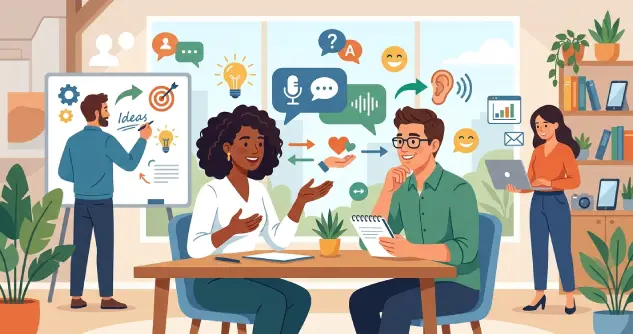
Communication skills are a set of abilities that help you express your thoughts, feelings, and needs clearly while also understanding what other people are trying to say, whether through words, tone of voice, or body language. They are essential skills that we use every day at work, in school, in personal relationships, and even in simple situations like having a conversation or solving a problem.
When you start to improve communication skills, you’re not only learning how to speak better. You’re also learning how to listen, understand others, and choose the right way to express yourself depending on the situation.
Communication skills include several connected areas, such as:
- Active listening: Paying attention to what the other person is saying and understanding them instead of only thinking about your response.
- Speaking clearly: Getting your ideas across in a simple and direct way without making things complicated or unclear.
- Body language: Using eye contact, facial expressions, and body posture in a way that supports what you’re saying.
- Tone of voice: Controlling your tone and speaking speed depending on the situation.
- Asking the right questions: Using questions to better understand others and encourage them to share their thoughts.
- Expressing feelings and opinions: Explaining how you feel and what you need without being aggressive or overly hesitant.
- Understanding nonverbal cues: Paying attention to facial expressions, body movements, and changes in tone of voice.
- Handling disagreements: Being able to discuss different opinions calmly and respectfully and work toward suitable solutions.
How to Improve Communication Skills Step-by-Step
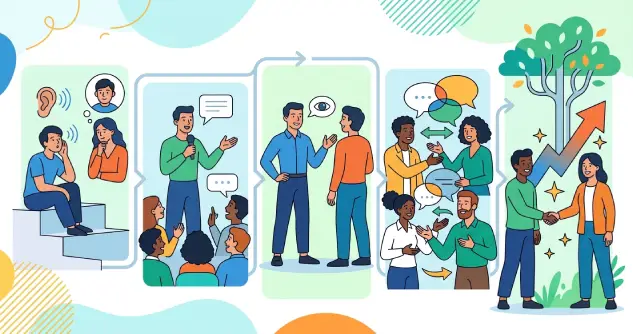
Improving your communication skills doesn’t happen overnight, but it becomes easier when you treat it as a skill that can be practiced and developed gradually. In the following steps, we’ll go through practical ways to help you improve communication skills and build a clearer and more confident communication style in your everyday life.
1. Start by Becoming a Better Listener
The first step to improve communication skills is learning how to listen better. Contrary to what it might seem, listening doesn’t simply mean staying quiet while the other person is talking. It means being present with them and genuinely trying to understand what they’re saying.
One of the biggest communication mistakes is thinking about your response while the other person is still talking. You might be busy preparing your argument or remembering a similar experience you’ve had, and as a result, you miss an important part of what the person is saying. Active listening helps you understand their words, feelings, and the message they’re trying to get across. It also makes them feel that you actually care about what they’re saying.
When you’re talking to someone, try to:
- Put your phone and other distractions aside.
- Look at them naturally while they’re speaking without staring constantly.
- Don’t interrupt just because you want to respond quickly.
- Wait until they finish their thought before you start talking.
- Ask a question if there’s something you didn’t understand.
- Try to understand the meaning behind their words, not just the words themselves.
- Use short phrases like I understand or Go on to show that you’re following the conversation.
It can also be helpful to repeat or rephrase what you heard when the topic is important, such as: So, you mean the main problem was…? This helps you make sure you understood the person correctly instead of building your response on a wrong assumption.
Sometimes, the best response you can give is simply to listen. Not everyone who talks to you is looking for a solution or advice. Sometimes, they just need someone who gives them the space to express themselves.
2. Think Before You Speak
Thinking before you speak is one of the simplest habits that can make a big difference in the way you communicate. It doesn’t mean you have to think about every single word you say. It simply means giving yourself a short moment to organize your thoughts before speaking.
This becomes even more important when you’re angry, stressed, or under pressure, because strong emotions can make you speak more harshly than you intended or say things you later regret.
Before you speak, ask yourself:
- What is the main point I want to get across?
- Do I really need to include all these details?
- Does the way I’m speaking actually express how I feel?
Then, try to start with the main idea and add only the details the other person needs. For example, instead of giving a long and confusing explanation about why you were late, you can start with the main reason and explain more if the other person needs it. This makes your words clearer and easier for others to follow.
Most importantly, taking a few seconds to think before responding isn’t a sign of weakness or lack of confidence. In many cases, people who take their time to think are better able to express themselves calmly and clearly.
3. Practice Speaking Clearly
Clarity is one of the most important parts of effective communication. You may have a great idea, but if you explain it in a confusing or unorganized way, other people may not understand what you mean.
Speaking clearly doesn’t mean using complicated words or talking formally all the time. In fact, someone with strong communication skills can explain both simple and complex ideas in a way that others can easily understand. Try to:
- Use clear and direct sentences.
- Avoid unnecessary filler and repetition.
- Choose words that fit the person and the situation.
- Speak at a moderate pace.
- Speak loudly enough for the setting.
- Pause briefly between important ideas.
- Start with the main point instead of going around it.
If you’re talking about a complex topic, break it down into smaller points instead of giving all the information at once. One useful way to practice is to try explaining a certain idea in just one minute. This exercise forces you to focus on the main point and leave out details that don’t really add value.
4. Pay Attention to Your Body Language
Communication isn’t only about words. You may say the right thing, but your body language can send a completely different message. For example, imagine you’re talking to someone while constantly looking at your phone. Even if you tell them, I’m listening, your actions may make them feel that you’re not really interested. So, when you want to improve communication skills, don’t ignore nonverbal signals.
Here are some parts of body language you can pay attention to:
- Natural eye contact.
- Facial expressions.
- Your body posture.
- Hand movements.
- Tone of voice.
- The appropriate distance between you and the other person.
Try to make sure your body language matches your words. For example, if you’re apologizing to someone, a sarcastic smile or an irritated tone can make your apology seem insincere, no matter how appropriate your words are.
However, don’t try to monitor every movement you make while talking. This can make you feel nervous and unnatural. The goal is simply to become more aware of the signals you’re sending without turning the conversation into something that feels forced or rehearsed.
5. Ask Better Questions
Good questions can completely change the way a conversation goes. They don’t just help you get information; they also show the other person that you’re listening and genuinely interested in understanding their point of view. Sometimes, we ask questions just to keep the conversation going, but open-ended questions can give the conversation more space and help the other person express themselves.
Instead of asking questions that can be answered with yes or no, try using questions that start with:
What? How? Why? What do you think?
For example, instead of:
Did you like the work?
You could ask:
What did you like most about the work?
And instead of:
Was your day difficult?
You could ask:
What made your day difficult?
This type of question makes the conversation feel more natural and often brings out details you wouldn’t have discovered by asking closed-ended questions.
6. Learn to Listen Without Judging
Good listening doesn’t mean that you have to agree with everything the other person says. You can completely disagree with them and still give them a chance to fully explain their point of view.
Someone may tell you about an experience that is very different from yours, or share an opinion you don’t agree with. In this situation, try not to judge too quickly or prepare a defensive response before they finish speaking.
You can use phrases like:
I understand your point of view.
Or:
I can understand why you see it that way.
This doesn’t necessarily mean that you agree with their opinion. It simply means that you understand what they’re trying to say.
This approach is especially useful during disagreements because it reduces the feeling that each person is trying to attack the other. It also makes the conversation a chance to understand each other instead of turning it into a competition to prove who is right.
7. Improve Your Emotional Awareness
Emotions have a direct impact on the way we communicate. When you’re angry, for example, your tone may become harsher. When you’re stressed, you may speak too quickly or have trouble organizing your thoughts. That’s why an important part of improving communication skills is learning to notice your emotions before they affect the way you speak.
Before having a sensitive conversation, ask yourself:
- What am I feeling right now?
- Am I angry with the person or with the situation?
- Am I really ready to have this discussion?
- Is this the right time for this conversation?
If you notice that you’re very emotional, it may be better to postpone the discussion for a little while until you calm down. This doesn’t mean avoiding the problem. It simply means choosing a time when you’re more able to express yourself calmly and rationally.
Over time, you’ll start to notice the connection between your emotions and the way you communicate. This awareness alone can help you avoid many impulsive responses.
8. Learn How to Express Yourself Assertively
Assertive communication is different from being aggressive or passive. An aggressive person tries to force their opinion on others, while a passive person may avoid expressing their needs because they’re afraid of bothering others. Assertive communication, on the other hand, means expressing your opinions and needs clearly while still being respectful.
Instead of saying:
You never respect my time.
You could say:
I get frustrated when plans change at the last minute, and I’d prefer to know ahead of time.
The second sentence doesn’t attack the other person’s character. Instead, it explains the problem, how it affects you, and what you need.
This approach is useful at work, in personal relationships, and even in everyday situations because it helps you set clear boundaries without turning the conversation into a confrontation.
9. Stop Assuming and Start Clarifying
Many communication problems start with assumptions. Sometimes, we think we know what the other person is thinking or why they acted a certain way, and then we build our reaction around that assumption.
You might think someone ignored you on purpose, when they may have simply been busy. Or you might assume someone is angry with you, when the real reason could be completely different. That’s why, when something isn’t clear, ask instead of guessing.
You can use phrases like:
- Could you explain what you mean?
- Do you mean that…?
- This is what I understood from you. Is that right?
- Can I understand what happened from your point of view?
These simple questions can prevent a lot of misunderstandings, especially when the topic is sensitive or when the original message could be understood in more than one way.
10. Ask for Feedback
If you really want to improve your communication skills, don’t rely only on your own judgment. You may have certain speaking habits that you don’t notice, while people who interact with you regularly might notice them. So, you can ask someone you trust and know will give you honest and respectful feedback.
You could ask them:
- Do I talk too fast?
- Do I interrupt people without realizing it?
- Is my explanation clear?
- Does my way of discussing things sometimes sound too harsh?
Try not to see feedback as criticism of your personality. The goal is to find things you can improve. For example, you may discover that you speak faster when you’re nervous, or that you tend to interrupt others when you’re excited about a topic. Knowing about these habits is the first step toward changing them.
11. Practice in Everyday Conversations
You don’t have to wait for a job interview or an important presentation to start developing your communication skills. The best place to practice is in your everyday life, because you’re constantly interacting with family, friends, coworkers, and people you meet in different situations.
Instead of trying to change everything at once, choose one skill and focus on it throughout the day.
For example, your goal for today could be to:
- Listen without interrupting.
- Ask an open-ended question during a conversation.
- Speak clearly and keep your point concise.
- Maintain natural eye contact.
- Express your opinion in an assertive way.
- Pause for a few seconds before responding in stressful situations.
At the end of the day, take a minute to think about one of your conversations. Ask yourself: What did I do well? And what could I improve next time?
This way, improving communication skills becomes more than just advice you read. It becomes a skill you practice regularly. Over time, these behaviors will start to feel natural, and you’ll find yourself communicating with others more clearly and confidently without having to consciously think about every step.
Common Communication Mistakes to Avoid
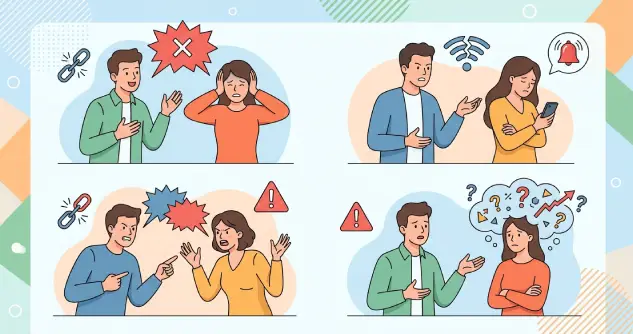
Even when you know the basics of good communication, there are some habits that can weaken a conversation without you even noticing.
- Interrupting Others:
Interrupting someone repeatedly can make them feel that you’re not interested in what they’re saying. Try to wait until they finish their thought, even if you already know what they’re going to say.
- Talking Too Much:
Not every silence needs to be filled with words. Sometimes, giving the other person space to speak can make the conversation much better.
- Using an Aggressive Tone:
The words themselves may sound normal, but your tone can make them come across as aggressive. So, pay attention to how you say something, not just the words you use.
- Checking Your Phone During Conversations:
Constantly looking at your phone sends a clear message that your attention is somewhere else. If the conversation is important, try to give the person in front of you your full attention.
- Trying to Win Every Argument:
The goal of every discussion isn’t for one person to win and the other to lose. In many situations, the real goal is to reach a mutual understanding or find a solution that works for both sides.
How Long Does It Take to Improve Communication Skills?
There’s no fixed amount of time that works for everyone when it comes to changing the way they communicate. You may notice some improvement after a few weeks of regular practice, but developing strong communication skills takes consistent practice over time.
The important thing is not to try to change everything at once. Choose one skill, such as listening, and focus on it for a week. Once you feel more comfortable with it, move on to another skill. This makes the process more gradual and easier to maintain.
A Simple Daily Practice to Improve Communication Skills
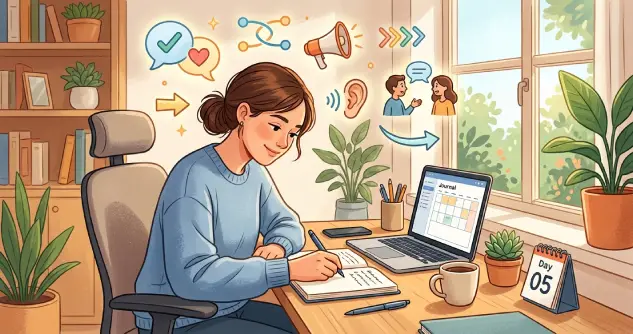
You don’t need to spend a lot of time every day to start improving your communication skills. Just 10 minutes a day can be enough to review the way you communicate and practice one skill at a time. The goal isn’t to become a perfect speaker, but to gradually notice your habits and work on improving them.
During the Conversation:
Choose one skill to focus on, such as listening without interrupting, speaking clearly, or asking better questions. Try to give the other person your full attention, and don’t plan your response before they finish speaking.
After the Conversation:
Take a minute or two to calmly think about the conversation and ask yourself:
- Was I clear when expressing my idea?
- Was I actually listening, or was I just waiting for my turn to speak?
- Did I interrupt the person without meaning to?
- Was my tone appropriate for the situation?
- Did my body language match what I was saying?
- Did I understand what the other person was trying to say?
- Could I have expressed my idea in a simpler or more respectful way?
Don’t use this review to criticize yourself. Instead, see it as a chance to learn. You might discover, for example, that you speak faster when you’re nervous or that you tend to give advice before the other person has finished explaining their problem.
As you repeat this exercise every day, you’ll start noticing your communication patterns and understanding your strengths and the areas you need to work on. Over time, the skills you’ve been practicing intentionally will become a natural part of the way you communicate with others.
Final Thoughts
Learning how to improve communication skills doesn’t mean becoming a completely different person or turning into a great speaker overnight. Good communication starts with simple things: listening carefully, thinking before you speak, expressing yourself clearly, and learning to understand others instead of assuming what they’re thinking. With practice, you’ll notice that these skills can help you not only in everyday conversations but also in your relationships, self-confidence, and professional life.
To get a complete picture of the different types of communication skills, how to develop them, and how to use them in different situations, you can check out our article, Communication Skills: The Complete Guide.
FAQs
How can I improve communication skills?
You can improve your communication skills by focusing on active listening, speaking clearly, paying attention to your body language and tone of voice, and asking the right questions. It’s also helpful to practice these skills in everyday conversations and ask for feedback from people you trust. The key is to keep practicing instead of trying to change everything at once.
What are 7 tips for improving communication skills?
You can start with these seven simple tips:
1. Listen carefully before thinking about your response.
2. Think about your point before you speak.
3. Use clear and direct words.
4. Pay attention to your body language and tone of voice.
5. Ask open-ended questions to better understand others.
6. Express your opinions and needs in an assertive and respectful way.
7. Review your conversations regularly to see what you could improve.
Practicing these habits regularly can help you become clearer, more confident, and more aware when interacting with others.
What are 10 tips to improve my communication skills?
If you’re looking for more comprehensive steps, here are 10 practical tips you can use in your everyday life:
1. Practice active listening.
2. Don’t interrupt others while they’re speaking.
3. Think before you speak, especially in sensitive situations.
4. Keep your words as clear and direct as possible.
5. Use appropriate body language that matches what you’re saying.
6. Pay attention to your tone of voice and speaking speed.
7. Use open-ended questions to encourage conversation.
8. Avoid making assumptions and ask for clarification when needed.
9. Express your feelings and needs assertively without attacking others.
10. Ask for honest feedback and apply what you learn in your everyday conversations.
You don’t need to practice all ten tips at the same time. Choose one or two skills and start practicing them regularly, then gradually add new ones. This makes the process easier and more sustainable.